Travel Insurance For Escorted Europe Tours: What Operators Actually Require
Schengen law does not make visa-free visitors carry insurance, but most escorted-tour contracts do. The difference between the two rules is the single most common thing travellers get wrong before booking a two week Europe package.
Short answer
Travel insurance is not a legal condition of entering the Schengen area for visa-free visitors, but Intrepid and G Adventures make it mandatory, Expat Explore makes it a condition of booking, and Contiki only recommends it. Intrepid and G Adventures each ask for cover around US$200,000 and proof on day one.
Travel insurance sits in an odd gap on an escorted Europe tour. The law that governs entry to most of the continent says nothing about it for visitors from the United States, Canada, Australia or the United Kingdom, yet the contract you sign with a tour operator very likely does. Four of the biggest names in escorted travel take four different positions, and two of them will refuse to let you board the coach on day one without a policy number. This guide sets out exactly what each contract says, what Schengen law actually requires, and how the two rules interact across the 21 multi-country packages listed on 14 Days Europe Tour Packages.
The distinction matters most at the moment of booking. A traveller who reads that "Europe requires insurance" online may buy the wrong thing, or buy nothing and assume the operator's price includes cover. Neither is true. What follows is drawn from the operators' own published booking conditions and from the primary EU legal texts, so every requirement named here can be checked against its source.
Do You Need Travel Insurance For An Escorted Europe Tour?
In practice, yes, because your tour contract almost certainly says so, even though the border does not. Schengen law lists five entry conditions for visa-free visitors and insurance is not one of them, but Intrepid makes insurance mandatory, Expat Explore makes it a condition of booking, G Adventures makes it mandatory with a stated minimum, and only Contiki stops at a recommendation.
The legal position comes first, because it explains why so much online advice is muddled. The Schengen Borders Code, the EU regulation that sets the rules for crossing the external border, lists the complete set of entry conditions for a stay of up to 90 days in any 180-day period: a valid travel document, a visa where one is required, justification of the purpose of the stay with sufficient means of subsistence, absence of an alert in the Schengen Information System, and not being considered a threat to public policy or security. Insurance appears nowhere in that list, which is the legal text published on EUR-Lex. Insurance is a requirement of a Schengen visa application, and US, Canadian, Australian and British passport holders do not make visa applications for a short stay.
The operator position is different and stricter. When you book an escorted package you enter a private contract, and that contract can impose anything lawful it likes, including a duty the border does not impose. Two operators on this site's roster make insurance a hard gate on day one, one makes it a condition of the booking itself, and one merely recommends it. The next section quotes each one.
There is a third layer worth naming: an individual border officer. The UK Foreign Office notes that at French and Italian border control a visa-free arrival may be asked to show proof of travel insurance, alongside proof of accommodation, sufficient money and a return ticket. That is not the same as a legal entry condition, but it means a traveller with no policy at all can face an awkward conversation at the desk. Carrying one removes the question.
Which Tour Operators Make Insurance Mandatory?
Intrepid and G Adventures both make insurance mandatory and both ask for proof on day one; Expat Explore makes adequate insurance a condition of booking and refuses embarkation without it; Contiki's booking conditions in all four regions say insurance is "highly recommended" and nothing stronger. The exact wording differs and the differences are worth reading before you pay.
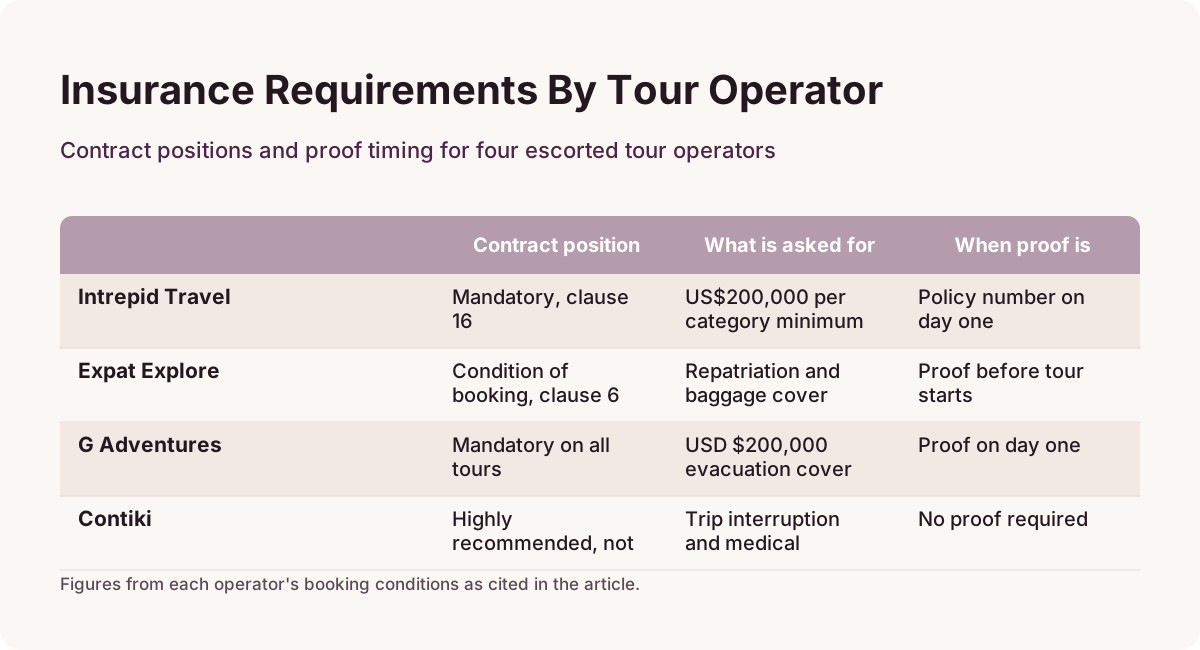
The four positions, in the operators' own words:
| Operator | Contract position | What is asked for | When proof is needed |
|---|---|---|---|
| Intrepid Travel | Mandatory, clause 16 of US Standard Booking Conditions | Personal accident, death, medical expenses, emergency repatriation; recommended minimum US$200,000 per category | Policy number and insurer's 24-hour emergency number on day one |
| Expat Explore | Condition of booking, clause 6 | Adequate cover including repatriation, cancellation, baggage | Proof before the tour starts, or no embarkation on day one |
| G Adventures | Mandatory on all tours | Medical travel insurance with at least USD $200,000 emergency evacuation and repatriation cover | Proof requested on day one |
| Contiki | Highly recommended, not required | Cover for trip interruption, injury, medical, evacuation and repatriation | No proof required |
Intrepid's own Standard Booking Conditions state it bluntly: travel insurance is mandatory for all travellers, must be taken out within a reasonable time after booking, and the policy number plus the insurer's 24-hour emergency contact must be produced on the first day of the trip. The clause adds that travellers "will not be able to join the trip without these details". That is a hard gate, not a formality.
Expat Explore, which runs seven of the 21 packages on this site, more than any other operator, phrases it as a condition of booking in its terms and conditions: if you cannot provide the team with proof of adequate insurance before the tour starts, you will not be permitted to embark on day one. The company sets no minimum coverage figure of its own and leaves the judgement of what is adequate to the traveller, which puts the burden of choosing sensibly on you.
G Adventures' booking FAQ requires medical travel insurance including at least USD $200,000 of emergency evacuation and repatriation cover on all of its tours, with proof requested on day one. Cancellation insurance is recommended but not mandatory.
Contiki is the outlier. All four of its regional booking conditions documents, for the US, UK, EU and Australia, carry identical wording: insurance is "highly recommended". The contract goes on to say the provider cannot be held responsible for a guest's failure to obtain appropriate insurance. So a Contiki traveller can legally board without a policy, but carries every resulting cost personally. Contiki's contractual age band, 18 to 35 on its core trips, is the other thing that sets it apart on this roster.
If you are still comparing which package to put a deposit on, these three give a spread of price points and formats across the same family of multi-country itineraries.
Each of those three listings states its own booking conditions, and the insurance clause is the one to read before paying anything. The cheapest of the three runs from $2,585 per person for 15 days, the mid-price option carries 309 reviews at a 4.6 rating, and the 12-day Europe Escape is the roster's most-reviewed package of all with 878 reviews. Whichever direction you lean, the insurance question is identical, so it is worth settling the policy question before the deposit question.
What Should A Policy Actually Cover On A Two Week Coach Tour?
A policy for an escorted Europe tour needs medical expenses and emergency repatriation at a minimum, and the two strictest operators recommend or require around US$200,000 per category. Beyond that, cancellation cover matters because none of the 21 packages on this site offers free cancellation, and baggage cover matters because coaches move your suitcase across borders every few days.
Start with the two headline items, medical and repatriation, because they are the ones the contracts name. Repatriation means getting you home if you are injured or ill, including medically, and it is the single most expensive thing that can go wrong on a foreign trip. Intrepid recommends a minimum of US$200,000 for each of its four covered categories, and G Adventures requires at least USD $200,000 of evacuation and repatriation cover specifically. A policy that meets one of those bars will comfortably meet the other.
Cancellation cover is the item travellers skip and then regret. Across this site's roster, zero of the 21 packages advertise free cancellation. Deposit and cancellation terms belong to each operator and sit in that operator's booking conditions, which is a separate subject covered in the guide to deposits, cancellation and booking windows. The practical link is simple: once you have paid a deposit on a four-figure land package, cancellation insurance is the only thing that can return that money if you cannot travel. G Adventures recommends it without requiring it, and Intrepid's clause strongly recommends it too.
Baggage and personal effects cover earns its place on a coach tour. A two week itinerary across eight or more countries means your main bag is handled at hotel after hotel, and a day bag rides with you through stations and cable cars. None of the packages on this site carries a verified figure for lost-baggage liability, so treat the operator's liability as unknown and let the policy carry the risk.
Two things a standard policy may not cover, which are worth checking in the small print. First, pre-existing medical conditions: Expat Explore's clause 6 specifically tells you to be satisfied your insurance covers them, and many cheap policies exclude them unless declared. Second, optional excursions: quad biking, paragliding or winter activities may sit outside a basic policy, and the extra activities sold on tour are covered as a cost question in optional excursions and hidden costs on Europe tours.
What Checks Happen On Day One Of The Tour?
On the morning of day one, a tour leader for Intrepid, Expat Explore or G Adventures will ask for your insurance policy number and, for the first two, the insurer's 24-hour emergency contact number. Contiki does not ask. Travellers who cannot produce the details for a mandatory-insurance operator are turned away from the trip, with the land package already paid.
The mechanism is worth understanding because it is not a border check and there is no arguing with it. The tour leader has a contract to uphold, and the contract says no policy number, no trip. Intrepid's clause 16 and Expat Explore's clause 6 both use wording to that effect in plain terms. G Adventures' FAQ says proof of coverage is requested on day one. In all three cases the check happens at the welcome meeting, usually in the departure hotel, before the coach has moved.

What this means for your paperwork is simple. Print the policy schedule or save it offline on your phone, and make sure it shows the policy number, the level of medical cover and a 24-hour emergency telephone number that works from Europe. A confirmation email without the emergency number is the thing Intrepid's clause specifically flags, so dig the number out of the policy documents rather than assuming the booking email has it.
It is also worth checking what your operator says about passports at the same moment, because the day-one meeting is where both documents get looked at. Intrepid requires a passport valid six months after the last date of travel, stricter than the three months Schengen law asks for, and the comparison is set out fully in passport validity rules for Europe tours. Six months beyond your return date is the safe number for both documents and policies: buy the policy early enough that it covers the whole deposit period, not just the travel dates.
Is Insurance Legally Required To Enter Europe?
No, not for visa-free visitors. US, Canadian, Australian and British passport holders enter the Schengen area under the 90-day rule without a visa, and insurance is a condition of a Schengen visa application, which those travellers never make. The confusion comes from visa advice pages that describe requirements those travellers do not face.
The root of the confusion is that a Schengen visa application does require medical insurance covering emergency care, hospitalisation and repatriation. Millions of travellers from countries that are not visa-exempt read that requirement, and their advice gets copied onto general pages aimed at everyone. If you hold a US, Canadian, Australian or British passport, you are on Annex II of the EU's visa regulation, the list of countries whose nationals are exempt from the visa requirement for stays of no more than 90 days in any 180-day period, and the visa file, insurance included, is not yours.
That said, the border officer retains discretion. As noted above, the Foreign Office advises that arrivals in France and Italy may be asked to show proof of insurance alongside proof of funds, accommodation and a return ticket. "May be asked" is not "must have", but the practical advice is unchanged: a traveller carrying a policy never has that conversation. The wider set of entry rules, including the 90/180 count and what EES does at the border, is covered in ETIAS and Schengen rules for a 14-day Europe trip.
One point of timing, because it changes over the coming seasons. ETIAS, the EU's planned travel authorisation for visa-exempt nationals, is not in operation and no applications are being collected. The EU expects it in the last quarter of 2026 and will announce the specific date in advance. Nothing about ETIAS adds an insurance requirement, but it is another item to have sorted before departure, and unlike insurance it cannot be bought yet.
Does A Balkans Itinerary Change The Insurance Picture?
It changes the border picture, not the insurance requirement. Serbia, Bosnia and Herzegovina, Montenegro, Albania, North Macedonia and Kosovo are outside Schengen, while Croatia is inside, so a Balkans loop crosses an external Schengen border more than once and EES registration can happen more than once on a single trip. Your operator's insurance clause is identical either way.
The reason this matters for a policy is that some travellers assume one border crossing means one set of paperwork. A 14-day Balkans itinerary that starts in Belgrade, loops through non-Schengen countries and dips into Croatia and back registers with the EU's Entry/Exit System each time it crosses into Schengen territory. EES has been fully operational at every external border crossing point since 10 April 2026, and manual passport stamping for short stays ended on that date. There is no fee and nothing a traveller does in advance, but the crossings take the time they take.
For insurance purposes, the practical points are geographic coverage and medical facilities. Check that the policy lists every country on the itinerary as covered, including the non-EU Western Balkans states, rather than a generic "Europe" definition that quietly excludes them. Medical costs in Serbia or Albania differ from costs in Switzerland, but repatriation distance is longer from everywhere, and repatriation is the cover the operators name first.
The Balkans packages on this site also illustrate why the semi-private and small-group end of the market reads its contracts closely. The Small Group: Balkan Essentials in 12 days package runs from $5,242 per person with a 4.8 rating across 27 reviews, a higher price point where a cancellation claim, if it ever came, would be worth proportionally more. The semi-private Athens to Sarajevo departure, 5 across 22 reviews and from $3,784, carries a maximum of 10 travellers, so a last-minute illness in a small group has a different financial shape than in a full-size coach. Neither listing replaces the need for the traveller's own policy, and both list some meals included with the land price.
How Does Insurance Interact With What The Package Price Covers?
The land package covers accommodation, some meals and internal transport, and it does not cover you if you fall ill, lose your bag or have to fly home in an emergency. On all 21 packages on this site the international flight is also excluded, so a medical evacuation home is a cost no part of the package price touches. Insurance is the only layer of the three that responds to a personal emergency.
It helps to see the three layers side by side, because travellers often assume one of them does a job it does not do.
| Layer | What it pays for | What it does not pay for |
|---|---|---|
| The land package | Accommodation for every night on 19 of 21 packages, some meals, internal transport between countries | International flights on all 21, medical costs, repatriation, anything personal going wrong |
| Your travel insurance | Medical expenses, emergency repatriation, cancellation, baggage, delay | The holiday itself, optional excursions, spending money |
| The operator's duty of care | A competent tour leader, vetted hotels, a roadworthy coach | Any cost arising from your lack of insurance, as each contract states |
The flight exclusion deserves its own sentence because it interacts with insurance directly. Every price on this site is a land price: the operators' own product pages list flights in the not-included block, and no verified airfare exists anywhere in this site's research. That means an emergency flight home after a broken ankle, exactly the scenario repatriation cover exists for, is never something the package price has any part in. The same logic applies to cancellation: if you cannot travel and the package price is forfeited under the operator's cancellation scale, cancellation cover is the only route to recovering it.
Two of the roster's budget listings show why the insurance question is not a premium-only concern. The 14-day Taste of Europe tour, from $2,238.12 with a 4.0 rating across 17 reviews, and the 14-day Madrid departure package, from $2,110.29 and genuinely new with no reviews yet, sit at the cheap end of the price span, and the money saved is real. But a medical bill does not scale with what you paid for the coach seat, and the lower the package price, the more of the total trip cost a policy's premium represents as protection rather than as a mark-up on an already expensive product.
How Do You Choose A Policy Before Paying A Deposit?
Buy the policy at or soon after the moment you book, because cancellation cover only works for events that happen after the policy starts, and Intrepid's clause requires insurance to be taken out within a reasonable time after booking. Match the medical and repatriation minimum to the strictest operator you might travel with, around US$200,000, and check the country list against your itinerary before you pay.
The sequencing is the part people get wrong. A policy bought the week before departure covers you on the trip but does nothing for the deposit you paid six months earlier, and the operators' cancellation scales bite hardest in the final weeks before departure, when the forfeited percentage is highest. Contiki's conditions recommend purchasing insurance at or soon after booking, and Intrepid requires it within a reasonable time after booking, which points the same way.

A short checklist, in the order the questions arise:
| Check | What to look for | Why it matters here |
|---|---|---|
| Medical and repatriation limit | At least US$200,000, ideally more | The figure Intrepid recommends and G Adventures requires |
| Country list | Every country on the itinerary, including non-Schengen Balkans states if applicable | A generic "Europe" definition may exclude them |
| Cancellation cover | The full land package price, deposit included | No package on this roster advertises free cancellation |
| Day-one details | Policy number plus a 24-hour emergency number | Intrepid and Expat Explore ask for these before you board |
| Pre-existing conditions | Declared and accepted in writing | Expat Explore's clause puts this duty on the traveller |
The final check is the one nobody thinks of: the operator's own booking conditions, not a summary of them. Each package's live listing links to the operator's terms, and the clauses quoted in this guide are the ones that decide whether you board the coach. Reading them takes ten minutes and settles the question of what your particular departure requires, which is worth more than any general rule of thumb.
For travellers weighing a mid-range classic itinerary, this package is the most-reviewed of the western Europe options and sits near the roster's median price.
What Does The Roster As A Whole Say About Insurance?
Across the 21 packages on this site, 19 include some meals and every night's accommodation, none includes flights, and none advertises free cancellation, which means the insurance decision is the traveller's alone on every single departure. The roster's own numbers show why: prices run from $2,110 to $5,265 per person, and a cancellation on any of them is a four-figure loss unless a policy is in place.
The site's own maths make the case more sharply than any general advice can. The median land package here costs $3,235 per person, and cost per day runs from $151 at the cheapest end to $437 at the most expensive. Ten of the 21 sit between $150 and $230 a day. Those are sums worth insuring, and the fact that Expat Explore alone runs seven of the packages means the "condition of booking" position is the single most common contract a reader of this site will sign.
The pattern across the roster also settles a question travellers often ask in the wrong order. Insurance is not a feature to compare between packages, because no package includes it and no operator sells it as part of the land price. It is a fixed step between shortlisting a package and paying for it, identical whether the departure in question is a $2,110 budget coach trip or a $5,265 fjords itinerary. The only thing that varies is the contract clause, and that takes a minute to check on the live listing.
If this guide has narrowed the choice down to a shortlist, these three packages between them cover the budget, mid-range and value ends of the same family of itineraries, and each listing states its own booking conditions in full.
Whichever of the three you lean toward, the sequence stays the same: read the operator's insurance clause, buy a policy that clears its minimum, and keep the policy number and the 24-hour emergency line with your passport. That is the whole task, and done in that order it takes an evening.
Common Questions About Travel Insurance On Escorted Europe Tours
Is Travel Insurance Legally Required To Enter Europe?
No, not for visa-free visitors from the US, Canada, Australia or the UK. Insurance is a condition of a Schengen visa application, and those travellers do not apply for a visa for a short stay. A border officer in France or Italy may still ask to see proof of insurance alongside proof of funds and accommodation.
Which Tour Operators Require Travel Insurance?
Intrepid Travel and G Adventures make insurance mandatory, with G Adventures requiring at least USD $200,000 of emergency evacuation and repatriation cover. Expat Explore makes adequate insurance a condition of booking and refuses embarkation without proof. Contiki only recommends insurance and does not require it.
What Happens If You Arrive On Day One Without Insurance?
On an Intrepid, Expat Explore or G Adventures departure, the tour leader will ask for your policy details at the welcome meeting, and the contracts state you cannot join the trip without them. On a Contiki tour nothing is checked, but the contract says the provider is not liable for costs arising from your failure to obtain insurance.
How Much Medical Cover Should A Europe Tour Policy Have?
US$200,000 of medical and repatriation cover is the working benchmark, because Intrepid recommends that minimum per category and G Adventures requires it for evacuation and repatriation. Higher limits cost little more and matter most for repatriation, the single most expensive claim type.
Does Travel Insurance Cover The Tour Price If You Cancel?
Cancellation cover can, and no package on this site advertises free cancellation, so the operator's cancellation scale applies to your deposit and balance otherwise. G Adventures recommends cancellation insurance without requiring it, and Intrepid's clause strongly recommends it. Check that the policy's cancellation limit is at least the full land package price.
Do You Need Insurance For A Balkans Tour That Leaves The Schengen Area?
Your operator's insurance requirement is unchanged, and a Balkans loop crosses the external Schengen border more than once because Croatia is inside and Serbia, Bosnia and Herzegovina, Montenegro, Albania and North Macedonia are outside. Check the policy's country list covers every country on the itinerary, not a generic Europe definition.