Europe Tour Package Deposit And Cancellation Terms Explained
The deposit is the moment a Europe tour package stops being browsing and becomes a contract. Across the 21 packages on this site, every deposit, every cancellation window and every refund rule belongs to the individual operator, and the differences between them are bigger than most travellers expect.

Short answer
Deposits and cancellation terms on the 21 Europe packages listed here are set by each operator, not by this site, and no single figure applies across the roster. None of the 21 offers free cancellation. Booking three to six months out lines up with the strongest departure calendars, which peak in May and September.
The price on a Europe tour listing is only half of the money conversation. The other half happens at the moment you pay a deposit, and it is governed by a document most travellers never open: the operator's booking conditions. Across the 21 packages on 14 Days Europe Tour Packages, every deposit amount, every cancellation deadline and every refund percentage belongs to the operator that runs the tour, and the operators on this roster take noticeably different positions on what they demand from you before day one.
This page walks through the mechanics in the order you will actually meet them: the deposit, the booking window, the cancellation terms, and the contractual small print on insurance and passports that can stop you joining a tour you have already paid for. Where this site's research verified a figure, it is printed. Where no operator publishes a number, that is said plainly, because a guessed deposit percentage is worse than none.
What Deposit Do You Pay To Book A Europe Tour Package?
The deposit is a fraction of the land price, paid upfront to secure your seat, with the balance due later under the operator's payment schedule. No operator on this roster publishes a standard deposit percentage in the listing data this site verified, so the exact figure is always in the operator's booking conditions. One thing is uniform: none of the 21 packages offers free cancellation.
That last sentence deserves emphasis, because a lot of comparison content implies otherwise. This site checked all 21 listings directly. Zero advertise free cancellation. What each one has instead is a deposit, a balance deadline and a sliding cancellation scale, all set out in the operator's own terms. The listing price you see, from $2,110.29 at the cheapest end to $5,265 at the top of the roster, is the land package per person, and the deposit is taken off that figure rather than off any flight, because international flights are not included on any of the 21.

Why does no single deposit figure appear here? Because the operators' product pages, the ones this site's research saved and read, present the deposit at checkout rather than in the itinerary description. Printing a plausible-sounding number like "10 percent" would be invention. What is verifiable is the structure: you pay a deposit, the operator holds the seat, and the balance falls due on a date the operator sets, typically counted back from departure. If you want the exact deposit on a specific tour, the operator's live listing shows it at the payment step, and the booking conditions linked from that listing govern what happens next.
The practical advice follows from the structure. Read the booking conditions before paying the deposit rather than after, because that is the document that tells you when the balance is due, what happens if you cancel the day after paying, and whether the operator moves departures. It is a ten-minute read that can save four figures.
How Far Ahead Should You Book A Two Week Europe Tour?
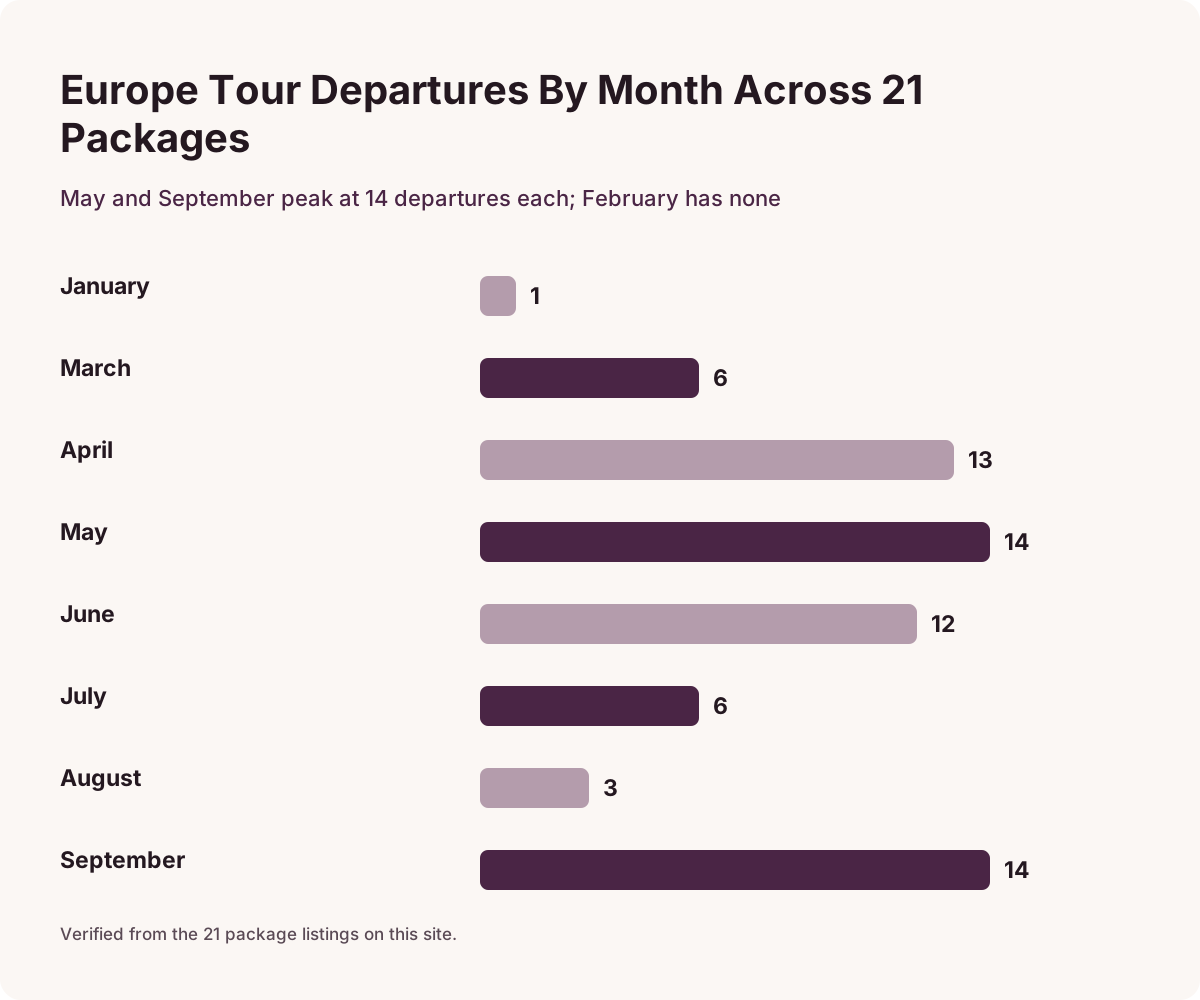
The departure calendars on this roster peak in May and September, with 14 products offering May departures and 14 offering September, so booking three to six months ahead puts you at the widest choice of dates and often the widest choice of tours. February appears on none of the 21 calendars, and January offers just one departure, so a winter booking window is about locking in a spring or summer seat early, not about travelling in February.
The month counts across the whole roster tell the story: January 1, March 6, April 13, May 14, June 12, July 6, August 3, September 14, October 10, November 2, December 3. February is absent entirely. That is a departure-calendar fact, read off the listings, and it shapes when the sensible booking window falls. If you want a September departure, the month with the most choice, you are typically booking between spring and early summer. Wait too long and the popular departures close.
Booking early also matters because of how the price ladder works on this roster. The cheapest land package, from $2,110.29 per person, and the median, $3,235, are both "from" prices, and operators on escorted tours generally hold a limited number of seats at the lowest tier. A late booker often pays a higher tier or misses the departure altogether. The cost-per-day spread is wide enough to make timing financially real: from $151 per day at the cheapest end to $437 at the most expensive, with ten of the 21 sitting between $150 and $230 a day.
If you are weighing which style of package to book at all, the comparison pieces on this site are worth a read before any deposit leaves your account: the cost breakdown for Europe tour packages covers what sits inside the headline price, and the guide to optional excursions and hidden costs on Europe tours covers the charges that arrive after booking. Both change what "affordable" means on paper.
What Are The Cancellation Terms On Escorted Europe Tours?
Cancellation terms are set by each operator in their own booking conditions, and none of the 21 packages on this site offers free cancellation. In general the money at risk rises as departure approaches: cancel early and you may lose the deposit or a modest percentage, cancel inside the final weeks and you can lose most or all of the land price. The exact percentages are contractual and per operator.
This site does not print a cancellation percentage table, and that is deliberate. No verified cancellation scale exists in the research for any of the 21 products. A table of invented percentages, the kind that appears on plenty of travel blogs, would be exactly the sort of plausible-sounding fabrication this site refuses to publish. What is verifiable is the framework every operator on the roster uses: a deposit at risk from day one, a sliding scale after that, and the operator's terms as the only document that counts.

There is one honest way to protect yourself inside this framework: cancellation insurance, bought separately, which can refund you when the operator's own scale will not. The operators themselves point at this from different directions. Intrepid's US booking conditions strongly recommend cover for cancellation and curtailment alongside the mandatory medical cover. G Adventures calls cancellation insurance recommended but not mandatory. Expat Explore's terms make you responsible for the cost of cancellation by you as part of its insurance condition of booking. None of that changes the operator's own scale, it just gives you a second route to your money back when you cancel for a covered reason.
The one thing never to assume is a grace period. Because zero of the 21 advertise free cancellation, the safest working assumption is that the deposit is committed the moment it is paid, and that anything you get back comes from the operator's published scale or from your own insurance policy. If a tour listing elsewhere promises free cancellation on an escorted Europe tour, read the conditions behind the promise, because the phrase is doing a lot of work.
Which Operators Make Travel Insurance A Booking Condition?
Four operators on this roster state their insurance positions in their own published terms, and they split cleanly: Intrepid Travel and G Adventures make insurance mandatory, Expat Explore makes it a condition of booking, and Contiki only recommends it. The distinction matters because Schengen law does not require insurance of visa-free visitors, so the only enforcement you will actually meet is the tour leader asking for your policy number on day one.
That legal point is worth pausing on, because it is the most commonly garled fact in this whole topic. Travel insurance is not a legal condition of entry to the Schengen area for visa-free visitors from the US, Canada, Australia or the UK. It is a legal requirement for a Schengen visa application, which those passport holders do not make for a short stay. The entry conditions in the Schengen Borders Code list documents, means and purpose of stay, and insurance is not among them, as the regulation itself shows. A border guard in France or Italy may still ask to see proof of insurance, but the hard requirement comes from your operator, not from EU law.
The operator positions, quoted from their own terms:
| Operator | Insurance position | What their own terms say |
|---|---|---|
| Intrepid Travel | Mandatory | Clause 16 of the US Standard Booking Conditions requires cover for personal accident, death, medical expenses and emergency repatriation, with a recommended minimum of US$200,000 per category; policy number and 24-hour emergency contact must be produced on day one or you cannot join |
| G Adventures | Mandatory | All tours require medical travel insurance including at least USD $200,000 of emergency evacuation and repatriation cover, with proof requested on day one; cancellation insurance recommended, not mandatory |
| Expat Explore | Condition of booking | Proof of adequate insurance must be provided before the tour starts, or you will not be permitted to embark on day one |
| Contiki | Recommended only | All four regional Booking Conditions describe insurance as "highly recommended"; the operator does not require it |
The sources are the operators' own published documents: Intrepid's standard booking conditions, Expat Explore's terms and conditions, the G Adventures booking FAQ, and Contiki's regional booking conditions. If you book a Balkans or Central Europe itinerary, check which operator runs it, because the same trip idea can carry a hard insurance requirement or none depending on the company behind it.
The practical takeaway for the deposit conversation: buy insurance at or immediately after booking, not the week before departure. Several of these operators ask for proof on day one, and a policy bought after you cancel for a covered reason will not pay out for that event. The timing of the insurance purchase is part of the booking mechanics, not an afterthought.
What Passport Validity Do Tour Operators Demand Beyond The Law?
Schengen law asks for a passport valid three months beyond your intended departure from the area and issued within the previous ten years, but two operators on this roster ask for more: Contiki and Intrepid both require six months of validity after the trip return date. Six months beyond return is therefore the safe number for any escorted Europe tour, and a passport that satisfies the law can still get you refused by the operator.
The legal baseline comes from Article 6 of the Schengen Borders Code: validity of at least three months after the intended departure date, and issuance within the previous ten years. Both are grounds for refusal at the border. The ten-year half of that rule has a specific trap for British passports renewed before October 2018, which can carry an issue date more than ten years old and still look perfectly valid, as the UK government's France entry requirements page spells out.

The operator layer sits on top of the legal one. Contiki's booking conditions require a machine-readable passport valid for six months after the trip return date. Intrepid's US conditions require six months after the last date of travel. Expat Explore sets no number of its own and instead puts the duty on the traveller to check. So the same passport can be legal for Europe and unacceptable to your tour company, and the tour company's word is the one that decides whether you board the coach.
| Requirement | Who sets it | The figure |
|---|---|---|
| Validity beyond departure from Schengen | EU law, Schengen Borders Code | At least 3 months |
| Issued within previous 10 years | EU law, Schengen Borders Code | 10 years from issue date |
| Validity after trip return | Contiki booking conditions | 6 months, machine-readable |
| Validity after last travel date | Intrepid US booking conditions | 6 months |
| Passport validity | Expat Explore terms | No operator figure; traveller's duty to check |
This belongs in a deposit-and-cancellation article because an invalid passport is one of the few things that can cost you the entire package with no refund sympathy. If you discover a passport problem after paying the balance, the operator's cancellation scale still applies to you. Check the passport before the deposit, not after the final payment.
Which Departure Months Give The Most Booking Choice?
September is the strongest month on this roster with 14 of the 21 products offering departures, followed by May with 14 and June with 12, so those three months give the widest choice of both dates and itineraries. August is surprisingly thin at 3 products, and February offers none at all. Booking a shoulder-month departure, in spring or autumn, maximises choice while avoiding the summer peak.
The full calendar counts, taken from the 21 listings: January 1, March 6, April 13, May 14, June 12, July 6, August 3, September 14, October 10, November 2, December 3. February appears on none of the 21 departure calendars. That is not a climate claim, it is a booking fact, and it does real work for anyone planning around school holidays or work leave.
For the deposit conversation, the calendar has a second use: it tells you when the booking pressure falls. With 14 products offering September departures, a September tour booked in spring has competition for seats. With only 3 offering August, an August traveller has fewer options to start with and should book whichever one fits early. The Christmas and New Year departure on the roster, Classic Europe Christmas & New Year at 5.0 across 17 reviews from $3,655, is the clearest case of a fixed-date product where the window closes on its own schedule.
One product on the roster is genuinely new and carries no rating and no reviews yet, the 14-day Madrid departure priced from $2,110.29. A new departure with an empty review column is not a warning sign by itself, but it is a reason to read that operator's booking conditions especially closely, since you are relying on contract terms rather than a track record.
What Happens If The Operator Cancels Your Departure?
If an operator cancels a departure, the booking conditions govern what you receive, and on escorted tours the typical outcome is a refund of what you paid or a transfer to another date, at the operator's option. No operator on this roster publishes a cancellation-by-operator compensation figure, so no number can honestly be printed here. The protection is choosing operators whose terms you have actually read, and keeping your own insurance in force from deposit to return.
Operator-side cancellations are rare on established Europe routes, but they are the mirror image of your own cancellation risk, and the terms run in the operator's favour in both directions. Where your cancellation triggers a sliding scale against you, an operator cancellation typically triggers a refund or re-accommodation clause. The detail lives in the same document as everything else on this page: the booking conditions.

Two roster facts help you gauge operator stability before paying a deposit. First, 12 named operators appear across the 21 packages, with Expat Explore Travel running 7 of them, more than any other company, and Trafalgar and Balkan and more running 2 each. Second, two products carry no operator name in the verified listing data, and this site does not attribute them to any company. A departure whose operator is not even named in the listing data is one where the booking conditions deserve extra scrutiny, because you cannot lean on a brand's reputation you have not been shown.
Review depth is the other signal. The most-reviewed product on the roster carries 878 reviews, and only 8 of the 21 carry more than 50. A four-figure purchase from an operator with hundreds of reviews, like the Europe Escape at 4.5 across 878 reviews from $2,715, has a visible service history behind its terms. That does not make a smaller operator a bad choice, it just changes what you are relying on when the deposit clears.
For travellers who want to compare operator reputations before committing money, the site's guide to the best Europe tour companies compared lays out the field. For timing, the guide to the best time of year for a 14 day Europe tour works through the calendar in more depth.
Is There Any Way To Reduce Your Money At Risk?
Yes, and all of it happens before you pay: read the operator's booking conditions, buy cancellation-cover insurance at the moment of booking rather than near departure, and check your passport validity against the operator's rule, not just the legal one. No package on this roster offers free cancellation, so every reduction in risk comes from your own timing and your own policy, not from the listing.
The honest sequence, in order. First, pick the tour and read that operator's booking conditions in full, paying attention to the balance due date and the cancellation scale. Second, check your passport against the stricter of the two validity rules, six months beyond return. Third, buy a travel insurance policy that covers cancellation for reasons you actually face, on the day you pay the deposit. Fourth, keep the policy number and the insurer's 24-hour emergency line somewhere the tour leader can be shown on day one, because two operators on this roster will ask.
The single-supplement question belongs here too, briefly, because solo travellers carry more money at risk per booking. No single-supplement figure is published for any product on this roster, so it cannot be printed, but it is a real line in the balance payment and the site covers the concept in full elsewhere, in single supplements and solo pricing on Europe tours. Ask the operator for the exact figure before paying the deposit, not after.
| Risk | When it bites | What reduces it |
|---|---|---|
| Deposit lost on cancellation | From the day you pay | Cancellation-cover insurance bought at booking |
| Balance due, then cancellation | In the final weeks before departure | Book only when your dates are firm |
| Refused at day one for missing insurance proof | Day one of the tour | Policy number and emergency contact ready; check the operator's position first |
| Refused for passport validity | Day one, or at the border | Six months validity beyond return, issued within ten years |
| Operator cancels the departure | Any time before travel | Read the operator's own cancellation clause before paying |
None of this is exotic. It is a checklist, and the whole thing takes an evening. The travellers who lose money on escorted Europe tours are rarely the ones who chose badly, they are the ones who paid a deposit without opening the terms attached to it.
Common Questions About Europe Tour Deposits And Cancellation
What Deposit Do You Pay To Book A Europe Tour Package?
The deposit is a fraction of the land price, set by each operator in their own booking conditions, and no standard percentage applies across the 21 packages on this site. The exact figure appears at the payment step on the operator's live listing. None of the 21 offers free cancellation, so treat the deposit as committed money from the day you pay it.
Do Any Europe Tour Packages Offer Free Cancellation?
No. This site checked all 21 listings and zero advertise free cancellation. Each operator runs its own cancellation scale from the booking conditions, and the money at risk rises as departure approaches. Cancellation-cover insurance bought at the moment of booking is the only route to a refund when the operator's own scale will not pay.
How Far Ahead Should You Book A Two Week Europe Tour?
Three to six months ahead lines up with the strongest departure calendars, which peak in May and September at 14 products each. February appears on none of the 21 calendars and January on just one, so winter booking is about locking in a spring or summer seat early rather than travelling in those months.
Is Travel Insurance Legally Required To Enter Europe?
No, not for visa-free visitors from the US, Canada, Australia or the UK making a short stay. Insurance is a legal requirement for a Schengen visa application, which those travellers do not make. The hard requirement comes from operators: Intrepid and G Adventures make it mandatory, Expat Explore makes it a condition of booking, and Contiki only recommends it.
How Long Must My Passport Be Valid For A Europe Tour?
EU law asks for three months of validity beyond your departure from the Schengen area and issuance within the previous ten years. Contiki and Intrepid both require six months beyond the trip return date, so six months is the safe number for any escorted tour. A passport that satisfies the law can still be refused by the operator.
What Happens If The Tour Operator Cancels My Departure?
The operator's booking conditions govern it, and the typical outcome is a refund of what you paid or a transfer to another date. No operator on this roster publishes a compensation figure for operator-side cancellations, so no number can honestly be printed. Keeping your own insurance in force from deposit to return is the practical protection.