Passport Validity Rules For Europe Tours: What Your Passport Needs Before You Book
Schengen law asks for three months of validity beyond your departure date and a passport issued within the last ten years. Tour operators ask for more. Here is exactly what each rule says, who enforces it, and how to check it before you pay a deposit.

Short answer
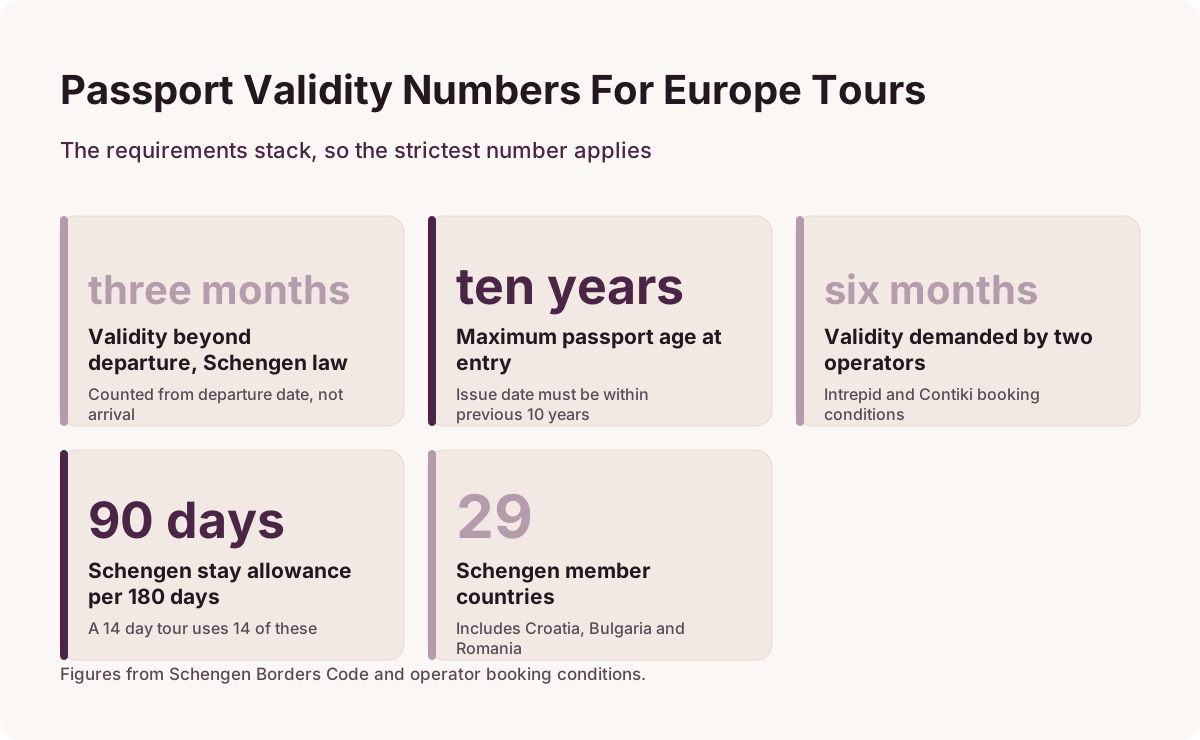
Schengen law requires a passport valid for at least three months after you leave the area and issued within the previous ten years. Intrepid and Contiki contracts demand six months beyond your return date. A 14 day tour uses only a fraction of the 90 day allowance, but an invalid passport voids the booking outright.
A passport that misses a validity rule by one week can end a Europe trip before it starts, and the rules do not all come from the same place. Schengen law sets one standard, the EU's future ETIAS system will add another, and two of the operators on this site impose a stricter six month demand in their own booking conditions. The three requirements stack rather than replace each other, so the number that matters is the strictest one that applies to your booking. This guide sets out each rule in its own words, using the official sources, and shows where a 12 to 16 day itinerary sits inside the 90 day Schengen allowance.
What Passport Validity Does Europe Legally Require?
Schengen law requires two things of every short-stay visitor: the passport must be valid for at least three months after the intended departure date from the Schengen area, and it must have been issued within the previous ten years. Both conditions appear in Article 6 of the Schengen Borders Code, and both are grounds for refusal at the border. Neither is a guideline.

The legal text is Regulation (EU) 2016/399, and its wording is precise. The passport's "validity shall extend at least three months after the intended date of departure from the territory of the Member States", and it "shall have been issued within the previous 10 years". You can read the full article on the Schengen Borders Code at EUR-Lex. An emergency waiver of the three month rule exists in the law, but it is discretionary, so no traveller should plan around it.
The three months count from your departure date, not your arrival date. On a 14 day tour that starts in Rome and ends in Paris, the clock runs from the day you fly out of Paris, so the passport needs roughly three months and two weeks of validity beyond the day you land. Travellers who plan a post-tour stay on their own need to count from their real departure date, not the tour's end date, which is the single most common way a valid-looking passport fails the test.
Note what the law does not ask for. It sets no minimum blank pages, no biometric requirement for visa-exempt nationals, and no insurance condition for visa-free visitors. The other demands you will meet, the six month operator rules and the ETIAS authorisation that is coming, come from contracts and from a system that is not yet live, not from border law.
How Does The Three Month Rule Work On A 14 Day Tour?
A 14 day tour consumes 14 of the 90 days the Schengen allowance permits in any 180 day period, so the stay itself is never the problem. The problem is the calendar at the back of the passport. If it expires inside three months of your departure date, the airline can refuse boarding and the operator can refuse the booking, and no amount of day counting fixes that.
The 90/180 rule counts backwards from each day of stay, which sounds complicated and is not. You look at any given day of your trip, count the 180 days before it, and total your Schengen days inside that window. A 12 to 16 day tour sits far inside the limit with roughly 74 or more days to spare. The only travellers who need to do real arithmetic are those who have already spent time inside Schengen in the previous 180 days, because earlier visits count toward the same 90 days.
Days spent outside Schengen do not count at all, and this matters on this site's roster. A Balkans loop through Serbia, Bosnia and Herzegovina, Montenegro, Albania and North Macedonia spends most of its days outside the area, dipping into Schengen only where the itinerary touches Croatia, which is a full Schengen member. A Britain and Ireland tour spends almost nothing inside Schengen if it stays on those islands, though the UK has its own ETA requirement, covered later in this guide.
The three month validity rule and the 90 day stay rule are separate tests, and a passport can pass one and fail the other. A passport with four months of validity left passes the validity test comfortably for a two week trip. The same passport in the hands of someone who has already spent most of their Schengen allowance on earlier trips this year fails the stay test regardless. Check both, in that order.
The tours below are the three listings this site most often compares on exactly this question, because their itineraries cross different mixes of Schengen and non-Schengen countries.
Why Do Tour Operators Ask For Six Months?
Two operators on this roster contractually require six months of passport validity beyond the trip return date, which is double the three months Schengen law asks for. Intrepid's US booking conditions demand it, and Contiki's booking conditions demand a machine-readable passport valid for six months after return. A passport that satisfies the law can still be refused by the operator.

The operator rules are not hidden. Intrepid's own terms state that "your passport must be valid 6 months after the last date of travel within the final destination as set out on your itinerary", published in Intrepid's standard booking conditions. Contiki's regional booking conditions go further and specify a machine-readable passport, valid for six months after the return date, plus applicable visas. Expat Explore, by contrast, sets no number of its own and puts the duty on the traveller to check.
Why the stricter number? Operators carry the operational cost of a traveller turned away at a border. A group departure cannot wait while one passenger negotiates with a border officer, and a passport that scrapes past three months today can look risky to an officer weighing a return journey. Six months gives a margin that no border in the area will question. The practical advice on this site is simple: six months beyond your return date is the safe number for any booking, and it satisfies every rule in this guide at once.
| Requirement | Who sets it | The exact demand | Where it is enforced |
|---|---|---|---|
| Three months beyond departure | Schengen Borders Code, EU law | Valid at least three months after leaving the Schengen area | Border control at entry |
| Issued within ten years | Schengen Borders Code, EU law | Passport issue date less than 10 years before arrival | Border control at entry |
| Six months beyond return | Intrepid booking conditions | Valid six months after the last date of travel on the itinerary | Tour operator, day one |
| Six months beyond return, machine-readable | Contiki booking conditions | Machine-readable passport valid six months after trip return | Tour operator, day one |
| No number set | Expat Explore terms | Traveller must check validity requirements themselves | Traveller's own responsibility |
Classic Europe, this site's related pick for entry planning, is a 14 day London round trip rated 4.6 across 309 reviews, from $3,185 per person. Its itinerary crosses the UK, which is outside Schengen entirely, so the passport rules that apply depend on which side of the Channel each leg sits on.
If your passport clears the six month test, the next question is which departure month fits both your calendar and the tour's, and that is worth checking against the operator's live listing before you commit.
Which Countries On A Europe Tour Are Schengen?
Schengen has 29 member countries, including Croatia, Bulgaria and Romania, all three of which are sometimes wrongly described as outside the area. The UK, Ireland, Serbia, Bosnia and Herzegovina, Montenegro, Albania, North Macedonia and Kosovo are outside. Which countries your tour crosses decides which passport rules apply on which days.
The official list comes from the European Commission: 25 EU member states plus Iceland, Norway, Switzerland and Liechtenstein. Bulgaria and Romania joined on 1 January 2025, the most recent enlargement. Croatia is a full member. The Commission maintains the official Schengen area list, and that page is the reference to check any claim against.
The distinction matters for two reasons. First, days outside Schengen do not consume the 90 day allowance. Second, every crossing from a non-Schengen country into a Schengen country is an external border crossing, which means EES registration can happen more than once on a single trip. A Balkan itinerary that enters Croatia, leaves for Bosnia and Herzegovina, then re-enters Croatia crosses the external Schengen border twice.
| Country on this roster's itineraries | Inside Schengen? | What that means for your passport |
|---|---|---|
| France, Germany, Italy, Netherlands, Austria, Switzerland | Yes | Three month rule and 90 day allowance apply |
| Croatia | Yes | Full member; crossings count as external Schengen borders |
| Bulgaria, Romania | Yes, since 1 January 2025 | Same rules as the rest of the area |
| United Kingdom | No | UK ETA rules apply instead, GBP 20 |
| Ireland | No, opt-out | Its own entry rules; no Schengen counting |
| Serbia, Bosnia and Herzegovina, Montenegro | No | Days do not consume the 90 day allowance |
| Albania, North Macedonia, Kosovo | No | Days do not consume the 90 day allowance |
| Cyprus | No, not yet | ETIAS country but not Schengen; passports stamped manually |
Ireland's position is unusual and worth knowing: it is an EU member with a formal opt-out from Schengen, so it runs its own border policy. Cyprus participates in Schengen cooperation but its internal border controls have not yet been abolished, so it is an ETIAS country without being a Schengen country, and passports there are still stamped manually.
What Is The Ten Year Passport Trap?
The second half of the Schengen rule catches travellers whose passport is still valid but too old: the issue date must fall within the previous ten years. British passports renewed before October 2018 often carry issue dates more than ten years back, because the UK used to add leftover validity from the previous passport, making them invalid for Schengen entry despite years of unexpired validity.

The UK government spells this out in its own travel advice: a passport renewed before 1 October 2018 "might have a date of issue that is more than 10 years ago, making it invalid for entry to the Schengen area", per the FCDO's entry requirements for France. The expiry date does not need to be within ten years of the issue date, only the issue date matters for this test. The rule applies to every nationality, not just British travellers, but British passports are where it bites most often.
The check takes ten seconds. Look at the issue date on the photo page. If it is more than ten years before your arrival date in Europe, the passport fails Schengen rules no matter how much validity remains. A passport issued under the old UK standard, which carried over up to nine months of leftover validity, can hold years of unexpired time and still fail this test on its tenth birthday.
No operator on this roster warns about the ten year rule in its booking conditions; they all assume the traveller holds a compliant document. That is why this check belongs before the deposit, not at the airport. A renewal inside the standard UK or US processing time is usually straightforward, but applications made close to a departure date carry their own risk, and a booked tour does not wait for a delayed passport.
What Is ETIAS And When Does It Start?
ETIAS, the EU's travel authorisation system, is not in operation and no applications are being collected. The EU expects it to become operational in the last quarter of 2026, with the specific date to be announced later by the European Commission. It will cost EUR 20, be valid for up to three years or until the linked passport expires, and apply to nationals of 59 visa-exempt countries.
The EU's own ETIAS site states plainly that "no applications for travel authorisations are collected at this point" and that the EU will announce the start date several months before launch. Anyone selling an "ETIAS application" today is selling something that does not exist yet; there is only one official ETIAS website, europa.eu/etias, and the EU itself warns about copycat services. The current status and timeline are published at the official EU ETIAS site.
When it does start, ETIAS will phase in. A transitional period of at least six months means travellers should apply but will not be refused entry without one, followed by a grace period of at least six more months with a narrow exception for first-time arrivals. The fee of EUR 20 is non-refundable, with exemptions for under 18s, over 70s, and qualifying family members of EU, EEA and Swiss nationals.
The scope detail worth knowing: ETIAS covers 30 European countries, the 29 Schengen members plus Cyprus, while Schengen itself has 29. The two counts differ, and using one for the other is a common error. A new passport also means a new ETIAS, because the authorisation links to the passport it was issued against.
What Happens At The Border With EES?
The Entry/Exit System has been fully operational at every external Schengen border crossing point since 10 April 2026, and manual passport stamping for short stays ended on that date. On first entry, border officers record your passport details and take a photo and fingerprints. Registration is free, and no action is needed before arrival, though it can add time at the border.

EES is live law, not a forecast, and the distinction from ETIAS matters. The system started on 12 October 2025 and phased in over six months; since 10 April 2026 it is fully operational everywhere it applies. The EU's own pages describe how it works at the official EES site. On later crossings your photo and fingerprints are already on file, so verification is quicker than the first registration.
For a coach tour, the practical effect is at the external borders. A western classics itinerary crossing from the UK into France registers once. A Balkan itinerary that enters and re-enters Croatia registers each time. The UK government advises travellers to be prepared to wait longer than usual, and no official source publishes a specific added minutes figure, so any number you read on that point is invented.
Two quirks close the picture. Children aged 11 or younger do not have fingerprints scanned, though they can be required to have a photo taken. And in Cyprus and Ireland, despite both being EU members, passports are still stamped manually, because neither is in the group of countries using EES.
What Else Can Invalidate A Booking?
Beyond validity, an operator can refuse a booking for a missing insurance policy, an age band you sit outside of, or a passport reported lost or stolen. Intrepid and G Adventures make insurance mandatory with proof on day one, Expat Explore makes it a condition of booking, and Contiki only recommends it. The UK ETA, GBP 20, is a separate requirement for any itinerary touching London.
The insurance contrast is genuine and verified from each operator's own terms. Intrepid's clause 16 requires cover for personal accident, death, medical expenses and emergency repatriation with a recommended minimum of US$200,000 per category, and the policy number plus the insurer's 24-hour emergency number must be produced on day one or the traveller cannot join. G Adventures requires medical travel insurance including at least USD $200,000 of emergency evacuation and repatriation cover on all its tours. Expat Explore states that travellers who cannot provide proof of adequate insurance before the tour starts "will not be permitted to embark on day one". Contiki's booking conditions, all four regional versions, say insurance is "highly recommended", not required.
Note what insurance is not: a legal Schengen entry condition for visa-free visitors. It is a condition of a Schengen visa application, which US, Canadian, Australian and British passport holders do not make for a short stay. A border guard in France or Italy may still ask to see proof of insurance, but that is an individual officer's discretion, not a statutory rule. The distinction between law and contract runs through every rule in this guide.
The UK ETA applies to any itinerary with a London leg, which includes several tours on this site. It costs GBP 20, covers visits of up to six months, and every traveller needs one, including babies and children, even when only transiting UK border control. British and Irish passport holders do not need one.
| Check before you pay a deposit | The standard to meet | Who enforces it |
|---|---|---|
| Passport validity | Six months beyond your return date | Strictest of law and operator terms |
| Passport issue date | Within the last ten years | Schengen border control |
| Schengen day count | 90 days in any 180, earlier trips included | Border control, automated under EES |
| Travel insurance | Mandatory for Intrepid and G Adventures, condition of booking for Expat Explore | Tour operator, day one |
| UK ETA if London is on the route | GBP 20, every traveller including children | UK border control |
| ETIAS | Not yet in operation; expected last quarter of 2026 | Applies once the EU announces a start |
Balkan Explorer, a 16 day Athens round trip rated 4.2 across 46 reviews from $2,665 per person, crosses the most external Schengen borders of the trio on this page, which is why the EES section above matters most to its travellers.
Best of UK and Ireland, 13 days from London, rated 4.7 across 449 reviews from $3,235 per person, spends its whole route outside Schengen, so the UK ETA and Irish entry rules replace the Schengen checks entirely for that itinerary.
For a full comparison of what sits inside a headline price and what gets added later, the guide on what is included in a Europe tour package breaks down the 19 of 21 packages that include accommodation and some meals. The booking terms themselves, deposits and cancellation windows, are covered in Europe tour deposits and cancellation windows, and the wider entry landscape is in ETIAS and Schengen rules for a 14 day Europe trip.
Across the 21 packages compared on 14 Days Europe Tour Packages, every itinerary is a land package with the long-haul flight booked separately, so the passport you check against these rules is also the passport you will fly on, and the same document has to satisfy the airline's boarding checks as well as the operator's day-one checks.
If the passport clears every rule in this guide, the choice between tours comes back to itinerary, pace and price, and these three listings cover the spread.
Common Questions About Passport Validity For Europe Tours
How Many Months Of Passport Validity Do I Need For Europe?
Schengen law requires at least three months of validity beyond your intended departure date from the area. Intrepid and Contiki booking conditions require six months beyond your return date, so six months is the practical standard for any tour booking on this site.
Does The Ten Year Rule Apply To My Passport?
Yes, if you are a visa-exempt visitor. The passport must have been issued within the previous ten years, regardless of how much validity remains. British passports renewed before October 2018 often fail this test because the UK used to carry over up to nine months of old validity onto the new issue date.
Do I Need ETIAS For My Europe Tour?
Not yet. ETIAS is not in operation and no applications are being collected. The EU expects it to become operational in the last quarter of 2026 and will announce the specific date several months in advance. Nothing needs to be applied for today.
Does A Balkans Tour Use Up My Schengen 90 Days?
Only the days spent inside Schengen countries count. Croatia is a full Schengen member, so days there consume the allowance, but Serbia, Bosnia and Herzegovina, Montenegro, Albania, North Macedonia and Kosovo do not. A 14 day tour uses only a small fraction of the 90 day allowance either way.
Is Travel Insurance Legally Required To Enter Europe?
No, not for visa-free visitors from the US, Canada, Australia or the UK. Insurance is a condition of a Schengen visa application, which those travellers do not make. It is, however, contractually mandatory with Intrepid and G Adventures, and a condition of booking with Expat Explore.
Do Children Need Their Own UK ETA For A London Leg?
Yes. The UK ETA costs GBP 20 and every traveller needs one, including babies and children, even when only passing through UK border control to continue elsewhere. British and Irish passport holders are exempt.