Rail Pass Versus Coach Tour Across Europe: Which Wins For Two Weeks
A rail pass and a coach package both move you across Europe for two weeks, but they are not the same product. One buys seats on trains, the other buys a whole trip with hotels, transport and some meals already arranged.
Short answer
Across the 21 packages on this site, land prices run from $2,110 to $5,265 per person, which works out to $151 to $437 a day and covers hotels, cross-border transport and some meals. A rail pass covers none of that, so the coach package usually wins on total cost for a two week trip.
A two week Europe itinerary by train sounds romantic, and often it is. But the question a reader is usually asking is narrower and more practical: if the plan is roughly fourteen days, several countries and a fixed budget, does a rail pass beat a packaged coach tour? The honest answer needs real numbers on both sides, and the numbers on the package side exist in plain sight. Across the 21 verified multi-country packages listed on 14 Days Europe Tour Packages, land prices run from $2,110 to $5,265 per person, and 19 of the 21 include accommodation for every night plus the internal transport between countries. A rail pass includes neither. That asymmetry, more than scenery or nostalgia, decides most comparisons.
This guide works through the trade honestly: what the pass buys, what the package buys, where each genuinely wins, and the border rules that apply to both. Where a figure is not verified, it says so rather than guessing.
Train Or Coach For Two Weeks In Europe?
For a fixed two week window with five or more countries, the packaged coach tour usually wins on total cost and certainty, because the headline price already contains the two biggest line items, hotels and cross-border transport. The rail pass wins on flexibility and city depth, but it leaves every night's bed and several cross-border connections to be arranged and paid separately, and those costs add up faster than most travellers expect.
The two products solve different problems. A rail pass is a seat entitlement: it lets its holder board trains across a set of countries for a fixed period, subject to reservation rules on the routes that need them. It is a tool for a traveller who already knows where they are sleeping, or is willing to book beds as they go. A coach package is a complete trip: the operator has already contracted the hotels, the coach, the driver and the tour leader, and the traveller buys the whole arrangement at once.
Neither is inherently the better product. The failure mode is comparing the wrong numbers, which happens constantly. People compare a pass price to a package price as if both bought the same thing. They do not. The package price contains accommodation for every night, and 19 of the 21 packages on this site also include the transport between countries. The pass price contains seats only. Add even modest hotel costs for thirteen or fourteen nights, plus the reservation fees that high-speed routes charge on top of the pass, and the gap narrows or reverses.
There is also a pacing difference that shows up in the itinerary itself. A 14-day coach circuit is built around a coach that has to be somewhere each night, so the route is fixed and the stops are confirmed in advance. A rail itinerary can be redrawn mid-trip if a city earns an extra night. That freedom is real, and for some travellers it is the whole point of going by train. For others it is a burden in disguise: fourteen days of nightly decisions is work, and the people who enjoy packaged tours are often the people who do not want that job.
What A Eurail Pass Actually Costs Against A Package
No rail pass price is verified anywhere in this site's research, so this comparison uses what can be verified: the package side. Land packages here run from $2,110 to $5,265 per person, a median of $3,235, which is $151 to $437 per day including hotels and cross-border transport. Any fair pass comparison must add fourteen nights of accommodation and reservation fees on top of the pass itself before the totals mean anything.
The right way to frame the money question is cost per day, because trip lengths on this site vary from 12 to 16 days and a headline price hides that. Ten of the 21 packages sit between $150 and $230 per person per day, and that daily figure is not a seat on a vehicle, it is the hotel room, the transport to the next country and usually some meals, all inside one number. A rail traveller has to assemble the same three items from separate suppliers, in a foreign currency, at prices that move with demand.
The table below shows the cheapest and the most expensive packages on this site, plus the mid-range, so the spread is visible. Every figure is a land price per person, in USD, exactly as the listings state it. Cost per day is only printed where the site's own roster maths state it.
| Package | Days | From price per person | What the price contains |
|---|---|---|---|
| Madrid, Paris, Venice, Rome coach trip | 14 | $2,110.29 | Hotels, coach transport between countries; group size on the listing |
| The Best of Eastern Europe | 14 | $2,249 | Hotels, transport, some meals |
| Classic Europe (London round trip) | 14 | $3,185 | Hotels, transport, some meals |
| Best of Central Europe, premium tier | 15 | $4,025 | Hotels, transport, some meals |
| Scenic Scandinavia and its Fjords | 14 | $5,265 | Hotels, transport, some meals |
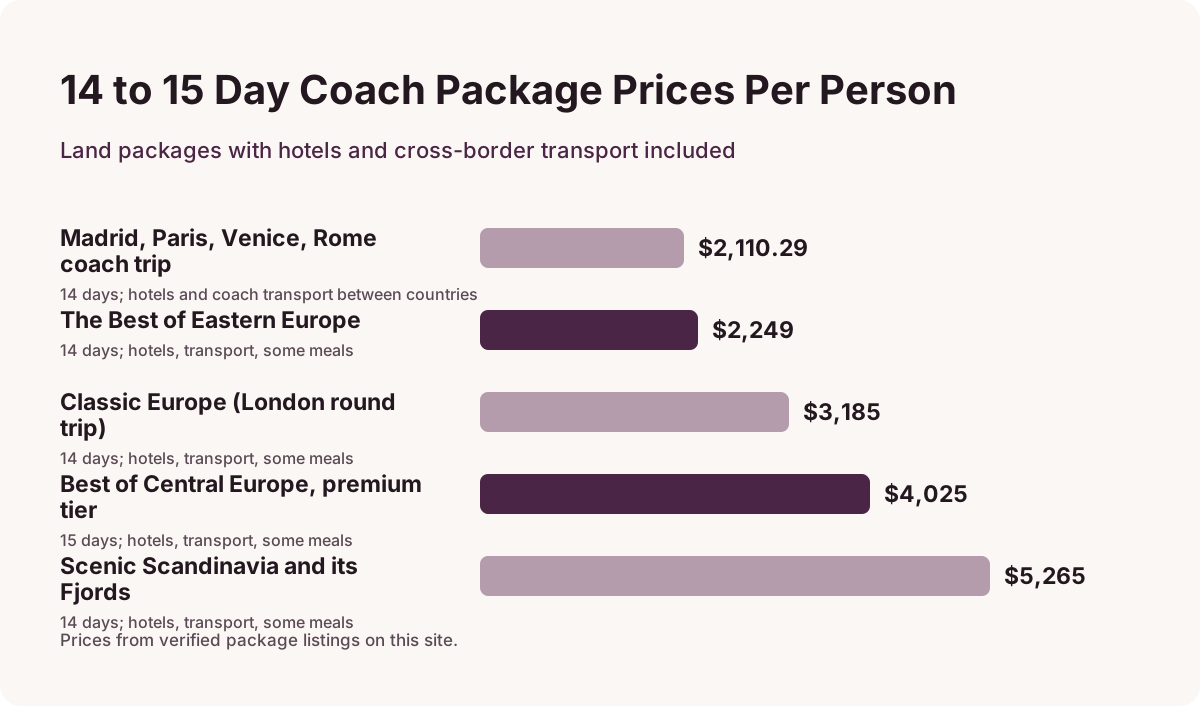
Two things jump out of that spread. First, the cheapest packages on this site are not much more than a bare-bones independent trip would cost once beds and trains are added, and they remove the booking work. Second, the premium end is a different product, not the same product marked up: premium tiers buy smaller-group formats, alpine country-road routing or fjord-focused itineraries. A rail pass competes with the budget end, not the premium end.
One more cost fact matters and it is buried in most comparisons: international flights are not included on any of the 21 packages. Every listing puts flights in its not-included block, and the two other products list no air either. The package price is a land price, and the long-haul ticket is always a separate cost the traveller books personally. No flight price is verified on this site, so none is quoted here. The same honesty applies to the pass side: whatever the current pass price is, it sits on the rail operator's own site, and it moves.
For a reader who wants the full arithmetic on package pricing, the Europe tour package cost breakdown unpacks every line item, and the Europe rail tour packages guide covers the rail-based alternative in depth.
Which Countries Can You Reach By Train In 14 Days?
Both formats can cover a lot of ground in two weeks, but they reach different places. The coach packages on this site cross between 2 and 10 countries per trip, with five of the 21 crossing exactly 8. Rail reaches everywhere the coach goes in Western and Central Europe, but the Balkan itineraries cross several countries outside the Schengen area where train networks are thinner and the coach holds a clear advantage.
The countries that appear most often across the 21 itineraries tell the story: Austria appears in 11, Germany in 11, Italy in 8, Switzerland in 8, France in 7, the Netherlands in 6. Those are precisely the countries with dense, fast, reliable rail networks, which is why the train-versus-coach question is a live one for Western Europe at all. A two week rail route through Amsterdam, Germany, Switzerland, Austria and Italy is genuinely practical, and plenty of travellers do it.
The Balkans are the counterexample. The five Balkans-and-Adriatic packages on this site cross Serbia, Bulgaria, North Macedonia, Albania, Montenegro, Croatia and Bosnia and Herzegovina, and several of those countries sit outside the Schengen area with rail networks that do not connect the way a coach road does. A coach itinerary that strings Belgrade, Sofia, Skopje and Tirana together works because one vehicle drives it. Replicating that by train means patching together services that in places do not exist daily, and the pass stops being the cheap or simple option.
| Region on this site | Packages | Typical countries | Rail practicality for a two week trip |
|---|---|---|---|
| Western Europe classics | 8 | France, Italy, Switzerland, Germany, Netherlands, Belgium | High, dense fast networks, pass works well |
| Balkans and the Adriatic | 5 | Serbia, Bulgaria, North Macedonia, Albania, Montenegro, Croatia, Bosnia | Low, several non-Schengen countries with sparse rail links |
| Central and Eastern Europe | 3 | Hungary, Czechia, Poland, Austria, Germany | Good, strong cross-border rail |
| Scandinavia and the Baltics | 3 | Denmark, Sweden, Norway, Finland, Estonia, Latvia, Lithuania | Mixed, long distances and ferry legs |
| Britain and Ireland | 2 | UK, Ireland | Separate rail systems, not covered by a mainland pass |
The Britain row carries a warning that catches people. A London leg is not covered by any mainland Europe rail scheme, and it is not covered by the EU's upcoming travel authorisation either. The UK runs its own ETA, which costs GBP 20, is needed by every traveller including babies and children, and is required even when only transiting UK border control. British and Irish passport holders do not need one. Several packages here start or end in London, so this is not a corner case.
For itinerary planning at country level, the 2 week Europe itinerary guide lays out how fourteen days actually split across destinations, and the how 14 days splits across Europe countries guide does the same arithmetic per day.
What The Coach Package Covers That The Pass Does Not
The package covers the three things a pass leaves out: 19 of the 21 packages include accommodation for every night of the trip, 19 of 21 include the internal transport between countries, and 19 of 21 include some meals, though never all meals. A rail pass covers train seats only, so every hotel night, every non-rail connection and every dinner is a separate booking the traveller owns personally.
The "some meals" phrase deserves a plain explanation, because it is the most misunderstood line on a package listing. It typically means breakfast at the contracted hotels plus a handful of dinners the operator includes at set stops. It never means all meals, on any of the 21 packages here. The traveller budgets for the rest, and the what is included in a Europe tour package guide walks through the whole inclusions block line by line, including the optional excursions that sit outside the headline price.
The pass side has its own hidden costs, and they are the reason naive comparisons fail. High-speed and international trains in much of Western Europe require seat reservations that are charged on top of the pass, not included in it. Overnight beds on night trains cost extra. Then there is the hotel problem: a rail traveller books fourteen nights alone, in cities where a tour operator has negotiated group rates, at dates that may coincide with events that spike prices. The package traveller has already paid for those nights at a rate set in advance.
There is also a service layer that is easy to undervalue until something goes wrong. The 20 joined-group packages on this site run with a tour leader whose job includes the hotel check-ins, the ferry bookings and the border paperwork. The semi-private Athens to Sarajevo product carries a dedicated tour leader and car for a maximum of 10 travellers. A rail traveller is their own tour leader, which is either the appeal or the cost, depending on the person.
The Classic Europe package is the standard example of the format: 14 days from London, 4.6 across 309 reviews, from $3,185 per person with some meals included. Its listing is on the site at Classic Europe, 14 days from London, and Check availability on the operator's live listing for current departure dates.
How Pacing Differs: Rail Freedom Versus Coach Schedule
A coach package paces the trip in advance, with confirmed stops and a fixed nightly route, so the traveller's planning work is done at booking. A rail itinerary paces itself, which means extra nights anywhere are possible but every night must be decided. On a 14-day trip the coach typically moves on a one-to-three-night rhythm per city, and the traveller who fights that rhythm will be happier on the train.
The pacing question is where the two products genuinely diverge, because it is about temperament as much as money. The group size and daily pacing on Europe coach tours guide covers the coach rhythm in detail, but the short version is that a well-built package alternates: a city with two nights, then a drive day with a photo stop, then another base. The traveller never chooses a hotel, never reads a departure board and never hauls a suitcase across a station concourse at rush hour.
The rail rhythm is the opposite. The traveller wakes up in a city and can stay another night if the city earns it, which is the single best argument for the pass. The trade is that the extra night must be found and booked, usually that morning, and a popular city in high season can simply be full. The coach traveller's bed is contracted months in advance.
Neither rhythm suits everyone, and the honest framing is to ask what the trip is for. If the goal is coverage, eight countries in fourteen days, the coach is built for exactly that and the rail version becomes a slog of early departures. If the goal is depth, three or four bases properly explored, the pass wins and the coach would feel like a schedule with a holiday attached.
Border Rules, ETIAS And What Changes At The Station
Both formats face the same border rules. The EU's Entry/Exit System has been fully operational at every external border crossing since 10 April 2026, replacing manual passport stamps. ETIAS is not in operation yet and is expected in the last quarter of 2026, and no applications are being collected. Schengen's 90/180 rule comfortably covers any 12 to 16 day trip on this site.
The border facts matter equally to both travellers, but the rail traveller meets them alone while the coach traveller has a tour leader who has done the crossing a hundred times. The Entry/Exit System registers facial images and fingerprints at first crossing instead of stamping passports, and the EU states it has been fully operational at all external border crossing points since 10 April 2026, per the official EU page on what the EES is. Later crossings only verify the recorded biometrics.
ETIAS is the one that gets misreported. It is not running, applications cannot be made, and the EU's own official ETIAS site states the launch date will be announced several months in advance. The expected window is the last quarter of 2026, and when it does launch it will cost EUR 20, with under 18s and over 70s exempt. A traveller booking a 2026 departure should watch the official site rather than any third-party page charging a fee on top.
The 90/180 rule is the one piece of arithmetic worth knowing, and it is not arithmetic at all on these trips: no more than 90 days in any rolling 180-day window, counted backwards from each day of stay, per the Schengen Borders Code on EUR-Lex. A 14-day tour uses 14 of those 90 days. The only travellers who need to do sums are those who have already spent time in Schengen countries in the previous 180 days.
The Balkan wrinkle matters for the rail-versus-coach question specifically. Croatia, Bulgaria and Romania are all inside Schengen, but Serbia, Bosnia and Herzegovina, Montenegro, Albania and North Macedonia are not, and days there do not consume the Schengen allowance. A Balkans loop that dips in and out of Croatia crosses an external Schengen border more than once, so EES registration can happen more than once on a single trip. On the coach, that is the driver's and leader's routine. On the train, it is the traveller standing in the queue. The full rules are unpacked in the ETIAS and Schengen rules for a 14 day Europe trip guide.
When A Rail Pass Genuinely Wins
The pass wins in three specific cases: a trip of three or four bases rather than eight countries, a traveller under 28 where youth pricing applies on the rail side, and a route that stays inside dense rail networks like Germany, Austria, Switzerland and Italy. It also wins for anyone whose trip falls in February, since none of the 21 packages here departs that month.
This guide has argued the package side on cost, and that argument holds for coverage trips. But an honest comparison names the cases where the train is simply the better tool. Depth trips are the clearest one: two weeks split between, say, three bases in Italy and Switzerland is a better rail trip than coach trip, because the coach format spends its value on movement between many places and a depth trip does not move much.
The February point is a genuine finding from the departure calendars, not an opinion. One of the 21 packages departs in January, three in December, and none in February. A traveller fixed on a midwinter departure is choosing an independent or rail trip by default, whatever their preference. The best time of year for a 14 day Europe tour guide covers the full calendar spread.
The youth-pricing point needs a caveat this site can source: no rail pass price is verified here, so the youth discount is a matter for the rail operator's own site. What is verifiable on the package side is that Contiki's core 18-35 age band is contractual, written into its booking conditions, not marketing, and Intrepid runs an "18 to 35s" themed range. Neither is a discount, but both are age-shaped products worth knowing about when the comparison is really about a younger traveller deciding between the two formats.
For everyone else, the practical test is simple. Count the hotel nights the pass trip needs, add the reservation fees on the fast routes, and compare that total to a package's cost per day. Ten of the 21 packages sit between $150 and $230 a day with beds and transport inside the number. That is the bar the rail trip has to beat, and most coverage-style itineraries do not beat it.
Booking Windows, Deposits And Cancellation Terms
Both formats need booking ahead, but the terms differ sharply. None of the 21 packages on this site advertise free cancellation, and deposit and cancellation rules sit in each operator's own booking conditions. A rail pass is typically refundable under its own conditions, but the hotels around it usually are not, so the independent trip's real cancellation exposure is spread across a dozen separate bookings.
The cancellation point is where the two products are least alike and where the package is often misunderstood. It is true that zero of the 21 packages advertise free cancellation, and that is a real cost of the format: once booked, changes are governed by the operator's own conditions, which the Europe tour deposits, cancellation and booking windows guide details. But the independent rail trip is not free cancellation either, in practice. It is a stack of a dozen non-refundable hotel nights, several non-refundable seat reservations and a pass, each with its own terms, and cancelling the trip means unwinding all of them individually.
Insurance is the other contract difference, and it is not the same across operators. The table below shows the four verified positions, each quoted from the operator's own published terms. The rail traveller faces no operator rule at all, though a border guard in France or Italy may still ask to see proof of insurance, and the travel insurance for escorted Europe tours guide separates the legal position from the contractual one.
| Operator | Insurance position | What the operator's own terms say |
|---|---|---|
| Intrepid Travel | Mandatory | Cover for personal accident, death, medical expenses and emergency repatriation, recommended minimum US$200,000 per category, proof on day one |
| G Adventures | Mandatory | Medical travel insurance with at least USD $200,000 of emergency evacuation and repatriation cover, proof requested on day one |
| Expat Explore | Condition of booking | Proof required before the tour starts, or the traveller cannot embark on day one |
| Contiki | Recommended only | "Highly recommended" in all four regional booking conditions, not required |
Passports deserve one line here because the operator rules are stricter than the law. Schengen law asks for three months of validity beyond departure and issue within the last ten years, but Contiki and Intrepid both ask for six months. Six months beyond the return date is the safe number for either format.
On the package side, the budget option makes a good worked example. The 14-day Taste of Europe tour from Paris covers France, Italy, Monaco, Switzerland, Germany and more, from $2,238.12 per person, 4 across 17 reviews. Its listing is at Taste of Europe, eight countries, with current dates and the operator's own booking terms on the live listing.
The premium contrast is worth a look for anyone whose rail comparison is really a comfort comparison. Best of Central Europe covers 15 destinations over 15 days, from $4,025 per person, 4.5 across 18 reviews, a different tier of the same format rather than a different product. For travellers deciding between first-class rail and a premium coach, the premium packages are the honest comparison point, and the escorted Europe tours guide lays out the full spectrum.
The Verdict For A Two Week Trip
For a two week, multi-country trip bought on a fixed budget, the packaged coach tour wins on total cost and certainty: 19 of 21 packages include every hotel night and the cross-border transport, at $151 to $437 per day. The rail pass wins on flexibility, February departures and depth trips of three or four bases. The deciding question is not price but whether the traveller wants to arrange fourteen nights themselves.
Both are good trips. The failure mode is buying the wrong one for the trip being imagined. A traveller who pictures eight countries, a fixed budget and a bed waiting every night is describing a package, and the roster here has twenty-one of them from $2,110 per person. A traveller who pictures three cities, a morning decision to stay a second night and a window seat is describing a pass, and no package will feel right.
Common Questions About Rail Passes Versus Coach Tours
Is A Rail Pass Cheaper Than A Coach Tour For Two Weeks In Europe?
Not usually, once the pass trip's hotel nights are counted. The packages on this site run $151 to $437 per person per day with accommodation and cross-border transport included, and ten of the 21 sit between $150 and $230 a day. A pass covers seats only, so fourteen nights of hotels and reservation fees must be added before any honest comparison. No pass price is verified on this site, so check the rail operator's own current pricing.
Do The Coach Packages Include Flights?
No. International flights are not included on any of the 21 packages. Every price on this site is a land price, the long-haul ticket is booked separately, and no flight price is verified anywhere in this site's research.
Can You Cover The Balkans By Train The Way The Coach Tours Do?
Not easily. The Balkan itineraries here cross Serbia, Bosnia and Herzegovina, Montenegro, Albania and North Macedonia, several of which sit outside the Schengen area with sparse cross-border rail links. The coach format works there because one vehicle drives the whole loop. Croatia, Bulgaria and Romania are inside Schengen.
Do I Need ETIAS To Book Either Option Now?
No. ETIAS is not in operation and no applications are being collected. It is expected in the last quarter of 2026, with the launch date to be announced by the European Commission. The Entry/Exit System is already fully operational at external borders since 10 April 2026, replacing manual passport stamping.
Do The Packages Offer Free Cancellation?
None of the 21 advertise free cancellation. Deposit and cancellation terms sit in each operator's own booking conditions, which vary by operator, so read them before paying a deposit. A rail trip's cancellation exposure is spread across separate hotel and reservation bookings instead.
Which Format Is Better For A First Trip To Europe?
For a first multi-country trip, the package usually reduces risk: hotels, transport and a tour leader are contracted in advance, and 19 of the 21 include every night's accommodation. The rail format suits travellers comfortable booking beds in foreign languages and handling border crossings alone. The escorted versus guided versus independent Europe tours guide breaks the choice down further.