Group Size And Daily Pacing On Europe Coach Tours
Pacing is the most common complaint in reviews of long Europe tours, and it is decided before you leave home. Here is how the 21 packages on this site split their days, their groups and their prices.
Short answer
Across the 21 verified packages on this site, trip lengths run from 12 to 16 days and land prices from $2,110 to $5,265 per person, or $151 to $437 a day. Only one product is semi-private with a cap of 10 travellers; the rest are joined group departures whose group size is stated on each operator's own listing.
Group size and daily pacing decide whether a two week Europe tour feels like a holiday or an endurance test, and neither is fixed by the destination. The same corridor of cities can be crossed in a 40 person coach with early starts, or in a van with ten travellers and long free afternoons. Across the 21 verified multi-country packages collected on 14 Days Europe Tour Packages, the spread is wide: 12 to 16 days, $2,110 to $5,265 per person, and everything from a semi-private departure capped at ten travellers to large joined groups. This guide sets out what the listings actually state, section by section, so you can compare departures on facts rather than brochure atmosphere.
What Group Size Actually Means On A Europe Coach Tour
Group size is the single biggest driver of how a fourteen day tour feels day to day, and on this roster it ranges from a semi-private cap of ten travellers to joined coach departures with no published headcount. Only one of the 21 packages is private or semi-private. The other 20 are group departures, and none of them publishes a numeric size, so the number sits on the operator's own listing, not in any third party summary.
The honest starting point is what this site's data does and does not contain. The verified roster records group size as a stated fact on exactly one product: the Athens to Sarajevo and Belgrade semi-private tour, which runs with a maximum of 10 travellers and a dedicated tour leader and car. Two further products, the Small Group Balkan Essentials in 12 days and the Small Group Balkan Extended from Budapest to Dubrovnik, describe themselves as small group in their official titles, but neither carries a verified numeric cap. For every other package, the group size is on the operator's listing and should be read there before booking, because no source on this site publishes a headcount for them.

What the format label tells you, even without a number, is how the days will be structured. A large coach tour usually means fixed morning departures, a set seat rotation and city walks led with a microphone or a whisper set. A small group tour usually means more flexibility in the schedule, a better chance of eating together as one table, and faster hotel check ins. A semi-private tour with a car and a dedicated leader can change the day on the fly, which is a genuine difference over fourteen days of border crossings.
| Format on this roster | Products | What the listing confirms | Numeric cap verified? |
|---|---|---|---|
| Joined group coach tour | 18 | Group size stated on the operator's listing | No |
| Small group (in the official title) | 2 | Small group format named in the title | No |
| Semi-private with car and leader | 1 | Maximum 10 travellers | Yes, 10 |
The pattern across the roster matters for expectations: 20 of the 21 are joined departures, so if a quiet van is what you want, the search narrows quickly to three products, and only one of those states its cap outright. For everyone else, the practical move is to ask the operator directly for the expected headcount on a specific departure date, since sizes vary by season even on the same itinerary.
How Trip Length Varies Across The Packages
Eleven of the 21 packages run exactly 14 days, four run 12 days, two run 13, three run 15 and one runs 16. Length is not a proxy for distance covered: the 16 day Balkan Explorer and a 12 day Scandinavia itinerary each cross a string of countries. Price per day, not total price, is the fairer comparison, and on this roster it runs from $151 to $437 per person.
The length split is the first fact to check when comparing itineraries, because a "two week" trip can mean 12 nights or 16. The verified counts are straightforward: 14 day products dominate with 11 of 21, and the tails are a 12 day cluster that includes Europe Escape from Rome and Best of Scandinavia, and a single 16 day product, the Balkan Explorer from Athens. Two Britain and Ireland products run 13 days each, and three products run 15 days, including Best of Central Europe and the Central and Eastern Europe Explorer.
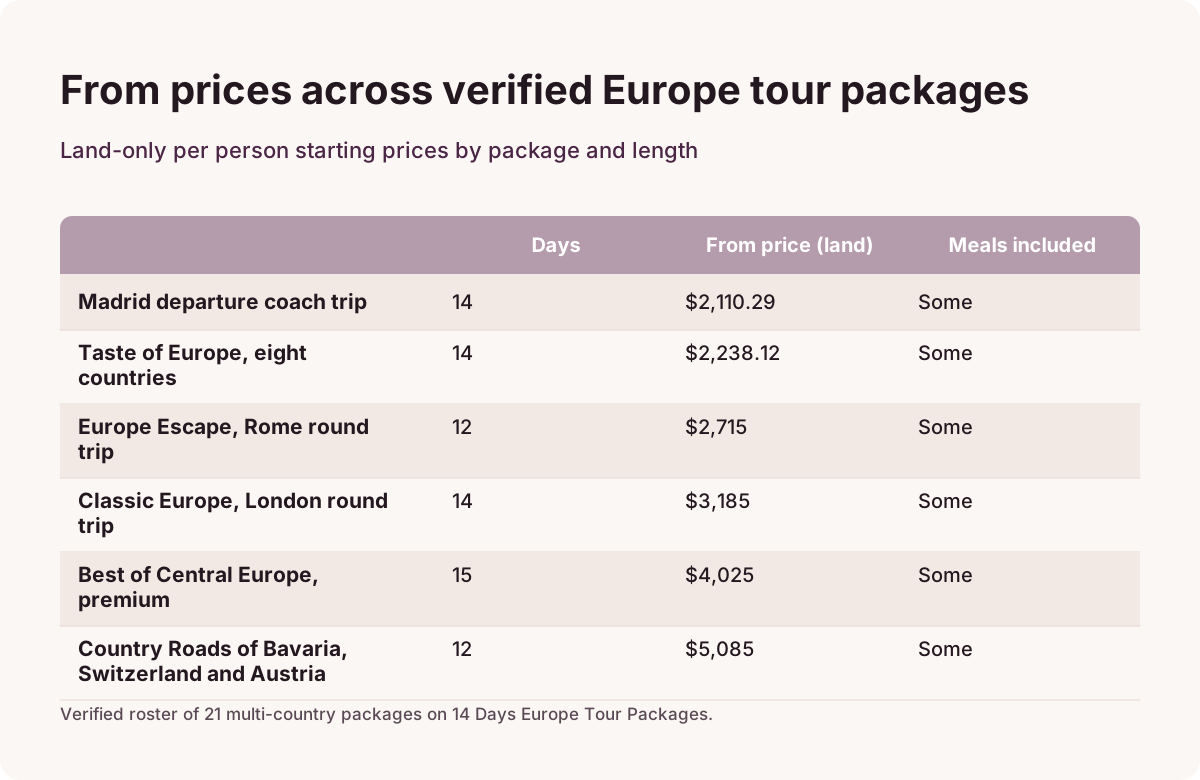
Price per day is where the roster gets interesting. The cheapest package by total price, the Madrid departure coach trip at from $2,110.29, is also the cheapest per day, while the premium alpine Country Roads product at from $5,085 for 12 days sits near the top per day. Ten of the 21 land between $150 and $230 a day, which is the practical middle of the market. The full price picture, including what sits inside and outside the headline number, is covered in the Europe tour package cost breakdown.
| Package | Days | From (per person, land) | Meals included |
|---|---|---|---|
| Madrid departure coach trip | 14 | $2,110.29 | Some |
| Taste of Europe, eight countries | 14 | $2,238.12 | Some |
| Europe Escape, Rome round trip | 12 | $2,715 | Some |
| Classic Europe, London round trip | 14 | $3,185 | Some |
| Best of Central Europe, premium | 15 | $4,025 | Some |
| Country Roads of Bavaria, Switzerland and Austria | 12 | $5,085 | Some |
Two cautions apply to any per day arithmetic. These are land prices: every one of the 21 products excludes international flights, a point the operators' own listings state in their not-included blocks, so the long haul ticket is a separate cost you book yourself. And none of the 21 advertises free cancellation, so deposit and cancellation terms come from the operator's own booking conditions rather than any blanket policy.
How Fourteen Days Split Across Countries And Borders
Most 14 day itineraries on this roster cross six to nine countries, which works out to roughly one and a half to two days per country. Austria and Germany appear on 11 itineraries each, Italy and Switzerland on 8. The pacing question is not how many countries, but how many border crossings and hotel changes the route forces, and that varies sharply between a western loop and a Balkans loop.
The country counts are the site's own roster maths. At the narrowest, a package crosses 2 countries; at the widest, 10; five of the 21 cross exactly 8. The countries that appear most often are Austria and Germany on 11 itineraries each, then Italy and Switzerland on 8, France on 7, the Netherlands on 6, and Belgium, Hungary and Serbia on 5 each. That frequency tells you where the mainstream routes concentrate: the western classics corridor from Amsterdam or London down through the Alps to Rome or Paris.
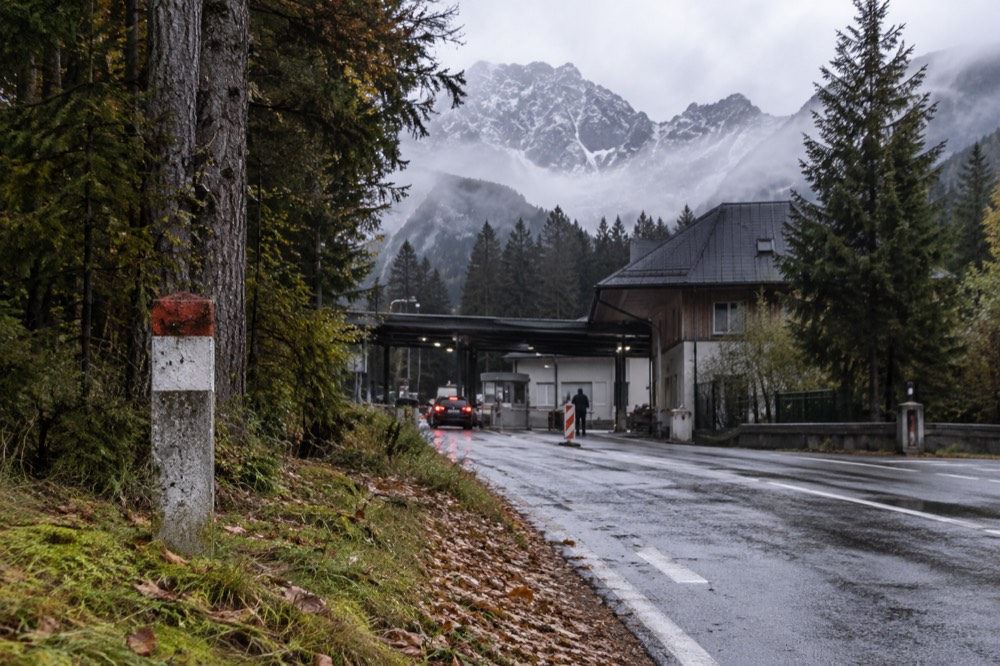
Border crossings are the hidden pacing cost, and the Balkans routes carry more of them than the map suggests. Serbia, Bosnia and Herzegovina, Montenegro, Albania and North Macedonia are all outside Schengen, while Croatia and Bulgaria are inside, so a Balkan loop that dips in and out of Croatia crosses an external Schengen border more than once. Since the EU's Entry/Exit System has been fully operational at every external border crossing point since 10 April 2026, each of those crossings involves the biometric registration the EU's official EES pages describe. A western route through France, Belgium, the Netherlands and Switzerland crosses internal borders where routine checks have largely gone. How the days distribute across stops is unpacked in how 14 days splits across Europe countries.
Pacing also shows up in the round trip versus point to point split. Eight of the 21 start and finish in the same city, such as Classic Europe's London round trip, which usually means a loop with no repeated hotel. The rest are point to point, like the European Whirl that ends in Paris, which trades the return drive for a flight home from a different airport. Neither is better; the point to point routes simply spend slightly more of their budget on distance and slightly less on backtracking.
What A Small Group Format Actually Buys You
The three small and semi-private products on this roster cost between $3,784 and $5,242 per person, well above the roster median of $3,235, and that premium is the clearest data point on what the format costs. What it buys is flexibility in the daily schedule rather than a different route: the destinations overlap heavily with the big coach loops.
Small group pricing on this site is unambiguous. The Small Group Balkan Essentials in 12 days runs from $5,242, the Small Group Balkan Extended from Budapest to Dubrovnik runs 15 days from $4,957, and the semi-private Athens to Sarajevo and Belgrade tour runs 14 days from $3,784. All three sit above the median land price of $3,235, and the two named small group products sit in the top four prices on the entire roster. The semi-private product, capped at 10 travellers with a dedicated car and tour leader, is the only product where a hard headcount is verified.
The ratings on these products are worth reading carefully, because the pools are small. Small Group Balkan Essentials carries 4.8 across 27 reviews, Small Group Balkan Extended carries 4.9 across 14 reviews, and the semi-private tour carries 5.0 across 22 reviews. Those are strong scores, but 14 to 27 reviews is a thin base compared with the 878 reviews on Europe Escape, so treat them as encouraging rather than decisive. The full small group market, including products beyond this roster, is covered in Europe small group tours.
What the format changes in daily terms is mostly time elasticity. A large joined coach group has to leave on schedule because the day is built around fixed hotel check in windows and a driver's legally capped hours. A ten person car can linger in Mostar or extend a lunch in Ohrid, and the tour leader can reshape the afternoon. Over twelve to fifteen days that compounding flexibility is the real product, and it is why the premium exists even though the countries visited overlap with packages costing half as much.
The Semi-Private Option And Who It Suits
One product on this roster is semi-private: the Athens to Sarajevo and Belgrade tour, 14 days from $3,784 per person, rated 5.0 across 22 reviews, with a maximum of 10 travellers, a dedicated car and a dedicated tour leader. It suits travellers who want the planning taken care of but cannot work with a coach timetable.
This is the only departure on the site where the group size is a verified number rather than a phrase. The cap of 10 travellers is confirmed on the operator's own wider listing material for this identical itinerary. The route runs point to point from Athens through the Balkans to Sarajevo or Belgrade, which means the traveller books one inbound flight and one outbound, and the operator handles the rest of the movement.
The trade is price against control. At $3,784 for 14 days it sits well inside the roster's per day range of $151 to $437, but it costs far more than the cheapest coach loops of the same length, and in exchange the daily schedule bends around the group rather than the group bending around the schedule. It is also worth saying what it is not: it is not private, since up to nine other travellers share the car, and it is not a luxury product in the hotel sense, since meals are not included on this tour. For travellers weighing this against independent travel, the comparison in escorted versus guided versus independent Europe tours sets out the middle ground.
The semi-private format also changes the border arithmetic from the earlier section, in your favour. A single car of ten clears the EES registration at each external crossing faster than a full coach, and on a route that crosses several non-Schengen borders plus Croatia's external Schengen boundary, that is a real daily time saving rather than a comfort detail.
Age Bands, Insurance And Other Contract Terms That Shape The Group
Only two age facts are verified on this site: Contiki's contractual 18 to 35 core range, with some trips banded 18 to 22, 27 to 35 or 35 to 45, and Intrepid's 18 to 35s themed range. No other operator on the roster publishes an average age. Insurance is a contractual condition with Intrepid, G Adventures and Expat Explore, but only recommended with Contiki.
Age shapes the group you travel with more than any brochure line, and the honest position is that most operators here do not publish a figure. For Trafalgar, Globus, Cosmos, Insight Vacations, Expat Explore and the Balkans specialists, no average age exists in this site's verified data, and any number you read elsewhere should be treated as anecdote. What is contractual is Contiki's band: its booking conditions state that trips are designed for a particular age group and that travellers must sit within the applicable band at the start of the trip, with the core range at 18 to 35 and small numbers of 18 to 22, 27 to 35 and 35 to 45 programmes. Intrepid runs an 18 to 35s themed range alongside its mainstream trips, and its US booking conditions also set a minimum age of 15 on most trips.
Insurance is the other contract term that decides whether you actually board the coach on day one. Intrepid's US standard booking conditions make travel insurance mandatory, with a recommended minimum of US$200,000 per category of cover and the policy number required on day one. G Adventures requires medical insurance including at least USD $200,000 of evacuation and repatriation cover on all its tours. Expat Explore makes adequate insurance a condition of booking and states plainly that travellers without proof will not be permitted to embark on day one. Contiki, by contrast, describes insurance as highly recommended rather than required in all four of its regional booking conditions. None of this is Schengen law: insurance is not a legal entry condition for visa-free visitors, a distinction the travel insurance for escorted Europe tours guide unpacks in full.
| Operator | Insurance position | Where it sits |
|---|---|---|
| Intrepid Travel | Mandatory, US$200,000 recommended per category, proof on day one | Clause 16, US booking conditions |
| G Adventures | Mandatory on all tours, USD $200,000 evacuation minimum | Booking FAQ |
| Expat Explore | Condition of booking, proof before day one | Clause 6, terms and conditions |
| Contiki | Highly recommended, not required | Regional booking conditions |
Passport rules follow the same pattern of operators going beyond the law. Schengen law asks for three months of validity beyond departure and issue within ten years, while Contiki and Intrepid both contractually require six months beyond the trip return date. Six months beyond return is the safe planning number, and the details are in passport validity rules for Europe tours.
Departure Calendars And Seasonal Pacing
September is the busiest month on the roster with 14 of 21 products offering departures, May follows with 14, and February appears on none of the 21 calendars. January offers just one departure. These are calendar facts, not climate claims, and they matter because the same itinerary paces differently with a full summer coach than a half empty one in October.
The departure month counts across the whole roster read as follows: January 1, March 6, April 13, May 14, June 12, July 6, August 3, September 14, October 10, November 2, December 3. February is absent entirely, which is a genuine gap: no operator on this site runs a February departure on any of the 21 packages. The shoulders dominate, with May and September tied as the most offered months, which lines up with how escorted operators schedule around both peak demand and driver hour regulations.
Seasonal pacing is where group size and calendar intersect. A September departure on a popular route tends to run closer to the operator's maximum headcount, which means the full timetable applies: fixed morning departures and less slack in the schedule. An October or November departure on the same itinerary often runs with fewer travellers, which can mean faster hotel check ins and occasionally a more flexible driver, though the itinerary itself does not change. The Christmas and New Year departure of Classic Europe, from $3,655, is the roster's clearest example of a seasonal variant: same 14 day framework, different crowd profile. The trade offs across the year are laid out in best time of year for a 14 day Europe tour.
| Month | Products offering departures | Month | Products offering departures |
|---|---|---|---|
| January | 1 | July | 6 |
| February | 0 | August | 3 |
| March | 6 | September | 14 |
| April | 13 | October | 10 |
| May | 14 | November | 2 |
| June | 12 | December | 3 |
How To Read A Listing Before You Commit
Read four things in order: the confirmed stops versus the optional ones, the included block, the not included block, and the operator's own booking conditions. On this roster, all 21 exclude international flights, 19 of 21 include internal transport, and 19 include some meals but never all. Any price you compare should be a land price plus your own flight budget.
The listings on this site mark a stop as confirmed only where the operator's own page confirms it, and conditional stops are recorded as options rather than promises. That distinction is the first thing to check, because two itineraries that look identical on a map can differ in whether a highlight city is a guaranteed overnight or a weather dependent detour. The second check is the meals line: 19 of 21 packages include some meals, none includes all, so the daily food budget is a real addition to the headline price.
The third check is the not included block, and on this roster it is consistent: flights appear there on every product, along with the optional excursions and incidentals that the optional excursions and hidden costs guide itemises. The fourth is the operator's booking conditions, which is where deposit sizes, cancellation windows, insurance requirements and passport rules actually live. The operators' contract pages, such as the Expat Explore terms, are the only authoritative source for those terms, and they differ operator by operator.
One roster wide caution closes the checklist. Zero of the 21 products advertise free cancellation, so do not assume a grace period exists. The booking window that matters is the one printed in the specific operator's conditions for the specific departure, and the deposits, cancellation and booking windows guide explains how to read it before paying anything.
Common Questions About Group Size And Pacing On Europe Coach Tours
What Is The Group Size On Europe Coach Tours?
On this roster, only the semi-private Athens to Sarajevo and Belgrade tour has a verified cap, at 10 travellers. Two further products name themselves small group without publishing a number, and the remaining 18 are joined group departures whose headcount sits on the operator's own listing. Ask the operator for the expected size on your specific departure date before booking.
How Many Days Do Most Europe Tour Packages Run?
Eleven of the 21 verified packages run exactly 14 days. Four run 12 days, two run 13, three run 15 and one runs 16. A "two week" label can therefore mean anything from 12 to 16 days, so always check the day count rather than the marketing phrase.
What Does A Small Group Europe Tour Cost?
The three small and semi-private products on this roster run from $3,784 to $5,242 per person for the land package, against a roster median of $3,235. That premium buys schedule flexibility and a smaller vehicle, not a different set of countries. International flights are excluded on all of them.
Is Travel Insurance Required On Europe Coach Tours?
It depends on the operator, not on European law. Intrepid and G Adventures make it mandatory, Expat Explore makes it a condition of booking, and Contiki only recommends it. Schengen law does not require insurance of visa-free visitors, but an operator can refuse you boarding on day one without it.
Which Month Has The Most Tour Departures?
September and May tie as the most offered months, with 14 of the 21 packages offering departures in each. February has none at all across the entire roster, and January has just one. These are departure-calendar counts, not weather claims.